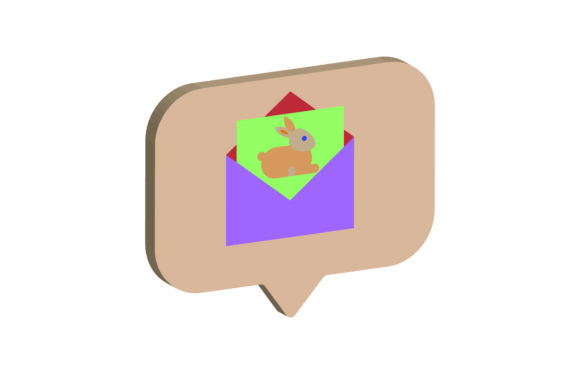
3D Easter Icon Bunny
The transition from traditional flat illustrations to volumetric, three-dimensional graphics has significantly altered the landscape of digital design, particularly within seasonal marketing and craft communities. As consumers seek more immersive visual experiences, the demand for assets that offer depth and realism has surged. In this context, the 3D Easter Icon Bunny represents a specific category of digital asset designed to bridge the gap between simple iconography and complex 3D modeling. This article provides an objective evaluation of this asset type, focusing on its technical specifications, usability across various platforms, and the practical implications for designers and small business owners.
Understanding the Asset Composition
When evaluating a digital product like the 3D Easter Icon Bunny, it is crucial to understand exactly what constitutes the deliverable. Unlike a standard image file that offers a single perspective, comprehensive design packages often provide multiple file formats to ensure versatility. The typical offering includes six distinct digital files, each serving a unique purpose in the design workflow.
The core resolution of these designs is generally standardized at 1920px by 1280px. This canvas size is significant because it aligns with common display aspect ratios, making the asset suitable for both web headers and high-resolution print materials without immediate distortion. However, resolution alone does not determine utility; the file format dictates how the asset can be manipulated.
- AI (Adobe Illustrator): This native vector file allows professional designers to edit paths, colors, and shapes directly within Adobe Illustrator. It is essential for users who need to make precise adjustments to the geometry of the bunny.
- EPS (Encapsulated PostScript): Similar to AI but with broader compatibility, EPS files are useful for older software versions or when working with printers that require legacy vector formats.
- SVG (Scalable Vector Graphics): This web-friendly vector format ensures the image remains crisp at any scale. It is ideal for responsive web design where the bunny icon must adapt to different screen sizes.
- DXF (Drawing Exchange Format): Often overlooked in general design but critical for fabrication. DXF files are used by laser cutters and vinyl plotters, allowing physical craftspeople to translate the digital design into tangible products.
- JPG (JPEG): A rasterized image format suitable for quick previews, social media posts, and basic editing in non-vector software.
- PNG (Portable Network Graphics): Providing transparency support, PNG files allow the bunny to be placed over any background without a bounding box, which is vital for layering in composite designs.
Evaluating Use Cases and Applications
The decision to utilize a 3D-style icon rather than a flat illustration depends largely on the intended medium. The 3D aesthetic adds a sense of tactility and modernity that flat vectors sometimes lack. For businesses aiming to create a premium feel, this asset offers a straightforward way to elevate their brand identity during the Easter season.
Digital Marketing and Social Media
In the realm of digital marketing, visual engagement is paramount. A 3D Easter Icon Bunny can serve as a focal point for email newsletters, landing pages, or social media advertisements. Because the SVG and PNG files are included, marketers can easily integrate the bunny into animated campaigns or overlay it onto promotional banners. The 1920x1280 resolution ensures that the graphic maintains clarity even when scaled up for large monitor displays or featured images.
Physical Product Creation
One of the most compelling reasons to acquire a multi-format package is the ability to produce physical goods. The inclusion of DXF and AI files makes this asset particularly valuable for makers and small manufacturers. A crafter using a Cricut or Silhouette machine can use the DXF file to cut vinyl decals, stencils, or wooden shapes. Similarly, the AI file provides the necessary precision for embroidery digitizers or laser engravers. This dual capability—digital and physical—maximizes the return on investment for the buyer.
Print Collateral
For traditional printing needs, such as flyers, postcards, or packaging, the EPS and JPG files ensure high-quality output. While raster images like JPGs have pixel limitations, the vector files (AI, EPS, SVG) allow for infinite scaling without loss of quality. This means the same bunny icon can be used on a business card and a billboard, provided the vector source is utilized.
Tradeoffs and Considerations
While the 3D Easter Icon Bunny offers numerous advantages, potential buyers should consider several tradeoffs. First, the "3D" appearance in vector files is often achieved through gradients, shadows, and highlights simulated in 2D space. This is known as faux-3D. While visually effective, it lacks the true rotational freedom of a rendered 3D model created in software like Blender or Cinema 4D. If a project requires rotating the bunny to view it from different angles, this asset will not suffice.
Secondly, ease of use varies by user expertise. The availability of AI and EPS files is beneficial only if the user has access to compatible software. Users relying solely on free or open-source tools may find themselves limited to the SVG, PNG, or JPG files. Additionally, while the files are described as "easy to edit," modifying complex gradient meshes in vector software can still present a learning curve for beginners.
Another consideration is the specificity of the design. Since the asset is a pre-made icon, customization options are finite. Users cannot alter the fundamental shape of the bunny beyond color changes or minor geometric tweaks. For brands requiring a highly unique mascot, this off-the-shelf solution may feel too generic.
Alternatives and When to Look Elsewhere
If the 3D Easter Icon Bunny does not align with your specific needs, several alternatives exist. For projects requiring true interactivity or animation, purchasing a rigged 3D model in FBX or OBJ format would be more appropriate. These files allow for movement and rotation in real-time environments, such as websites built with Three.js or virtual reality applications.
Conversely, if budget constraints are tight and no physical production is planned, a simple flat SVG bundle might be sufficient. Flat designs are often easier to animate and load faster on web pages. Furthermore, if the goal is purely decorative text-based design, exploring typography-focused Easter assets might yield better results than icon-based graphics.
Decision-Making Insights
To determine whether this asset is the right fit, consider the following checklist:
- Do you need both digital and physical outputs? If yes, the inclusion of DXF and AI files makes this a strong candidate.
- Is your audience primarily online? The SVG and PNG formats ensure optimal performance and visual fidelity across devices.
- Do you have vector editing capabilities? Access to Adobe Illustrator or Affinity Designer will unlock the full potential of the editable files.
- Is consistency across media important? Using the same source file for web and print ensures brand coherence.
In conclusion, the 3D Easter Icon Bunny serves as a versatile tool for designers and entrepreneurs looking to capitalize on seasonal trends. Its strength lies in its multi-format delivery, which supports a wide range of applications from web design to laser cutting. By understanding the technical nuances of the included files and aligning them with specific project goals, users can effectively leverage this asset to enhance their creative output.